Showing posts with label UNCG Preservation. Show all posts

Friday, September 6, 2024

 The Restoration of Letters from New York

by Audrey Sage


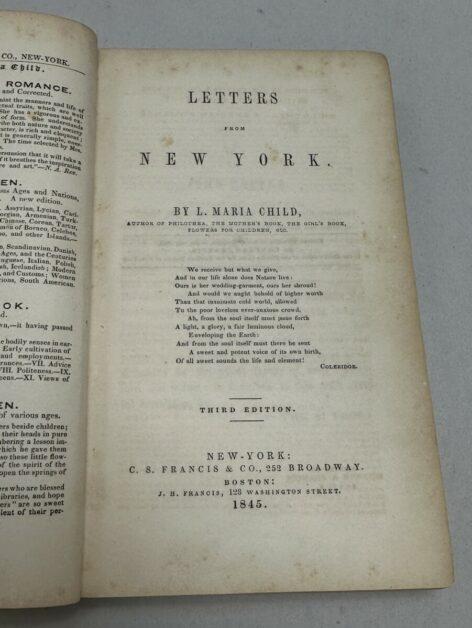
The Special Collections contains a copy of Letters from New York by L. Maria Child, which was published in 1845 by C. S. Frances & Co. in New York. Other works by L. Maria Child include Philothea: A Grecian Romance, History of Women, The Mother's Book, and Flowers for Children.

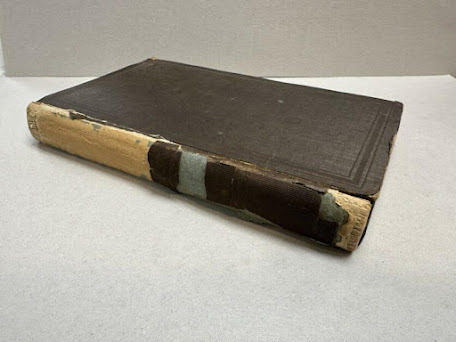
A book with a brown cover

Description automatically generated with medium confidence
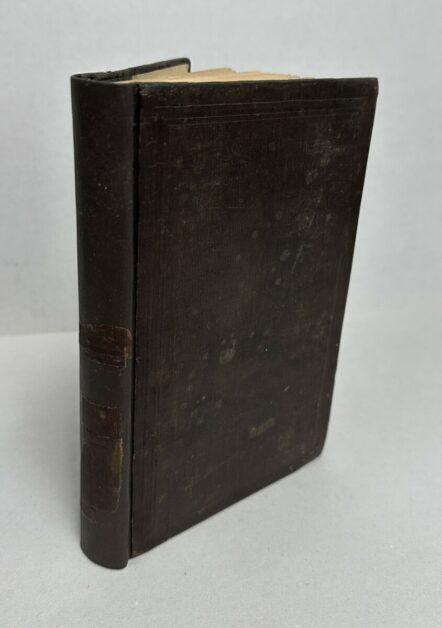
Before restoration
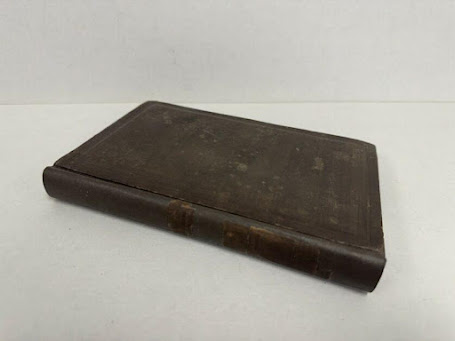
A book with a leather cover

Description automatically generated
After restoration

An open book with text on it

Description automatically generated
Prominent author and abolitionist Lydia Maria Child began writing her "letters" from New York in August 1841 as a response to the troubling realities marking her private and public life. In particular, she was preoccupied by her editorial duties at the National Anti-Slavery Standard and dismayed by the growing sectarian spirit of antislavery reform. Collected primarily from the pages of the Standard, her literary essays on women's rights, the preaching of African American minister Julia Pell, the Crosby Street Synagogue, animal magnetism, the engineering miracle of Croton Aqueduct, and countless other people, topics, and events capture the breathless and sometimes unsettling transformation of one representative hub of national life. - University of Georgia PressA close up of a book

Description automatically generatedA close up of a book

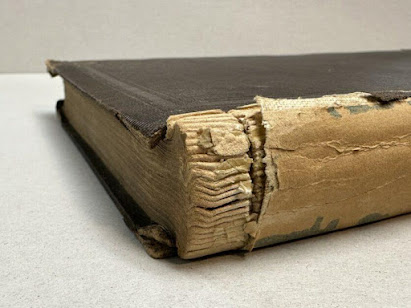
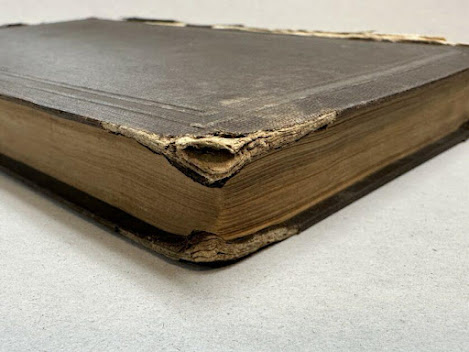
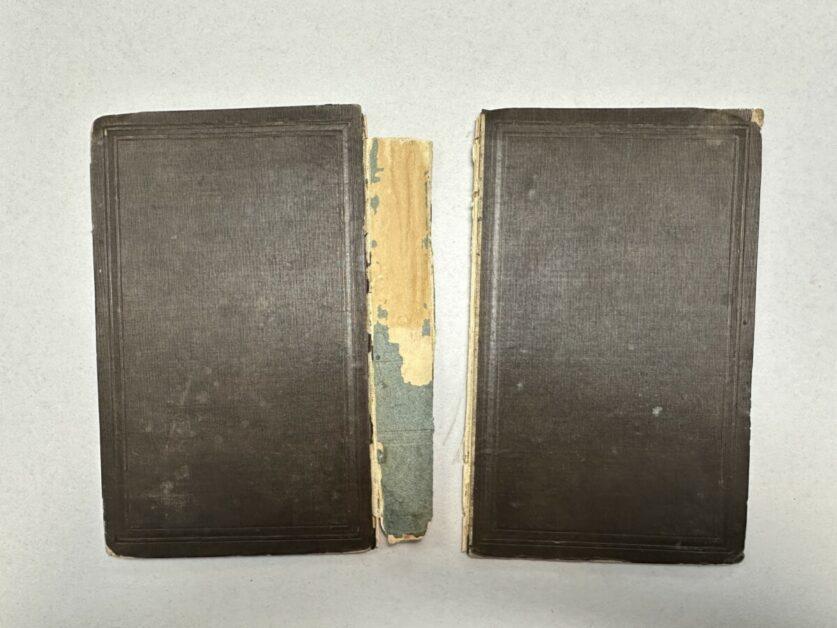
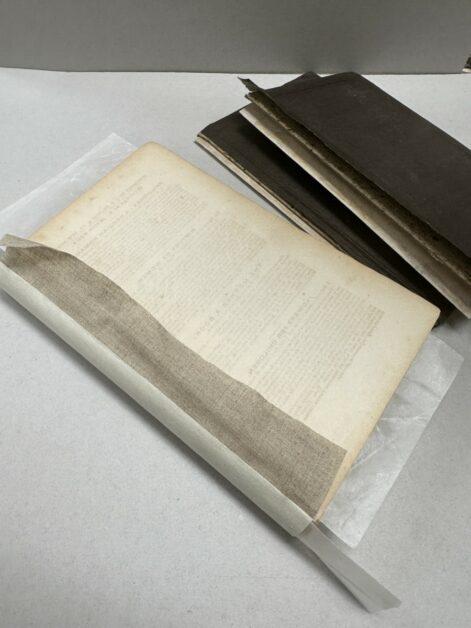
Description automatically generatedThis third edition of "Letters from New York" had become worn and in need of restoration treatment. I began the work by removing the covers from the text block in order to perform the mends necessary before I would be able to rebuild the cover. A broken book with a hole in it

Description automatically generated


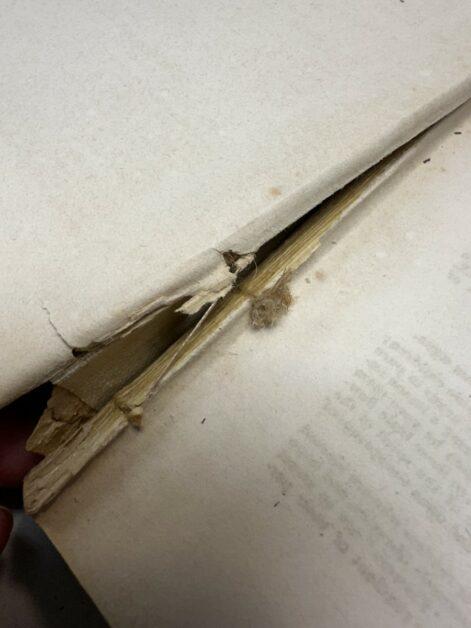
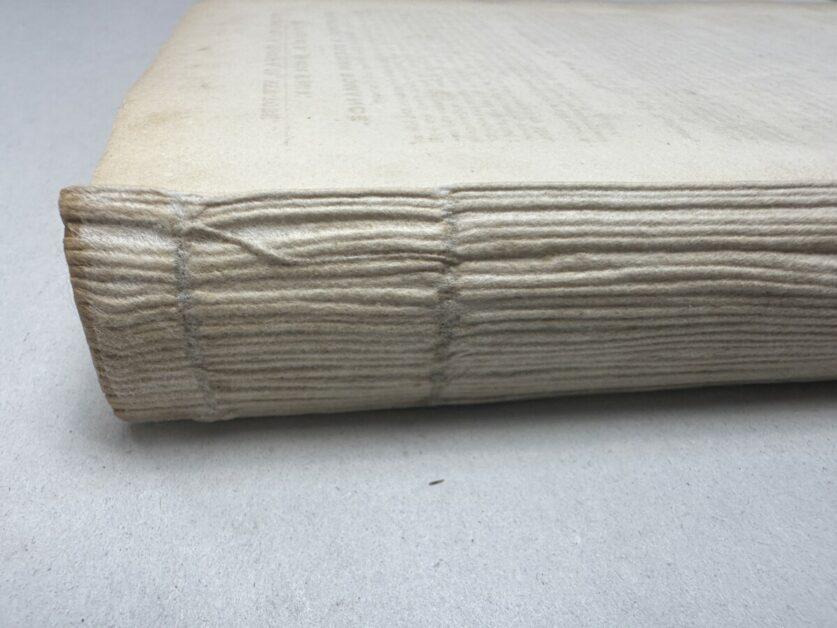
The text block signatures were somewhat loose due to the poor condition of the original adhesives, as well as the unfortunate tearing of the backing cloth. 

A close up of a book

Description automatically generatedA close-up of a book

Description automatically generated

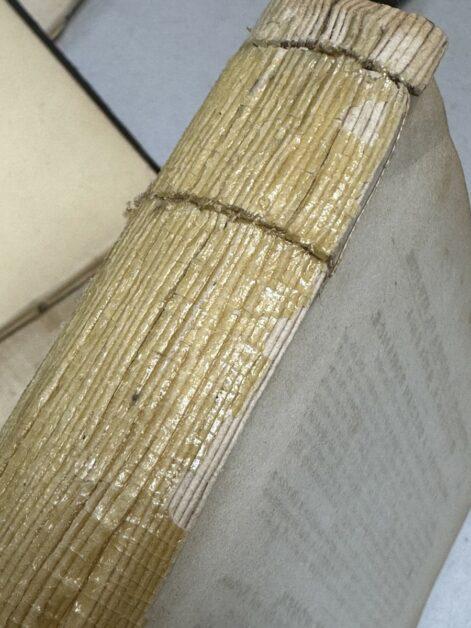
I was able to remove the old glue and apply new starch adhesive and archival mending tissue to reinforce the spine, salvaging the original sewing.

A close-up of a book

Description automatically generated

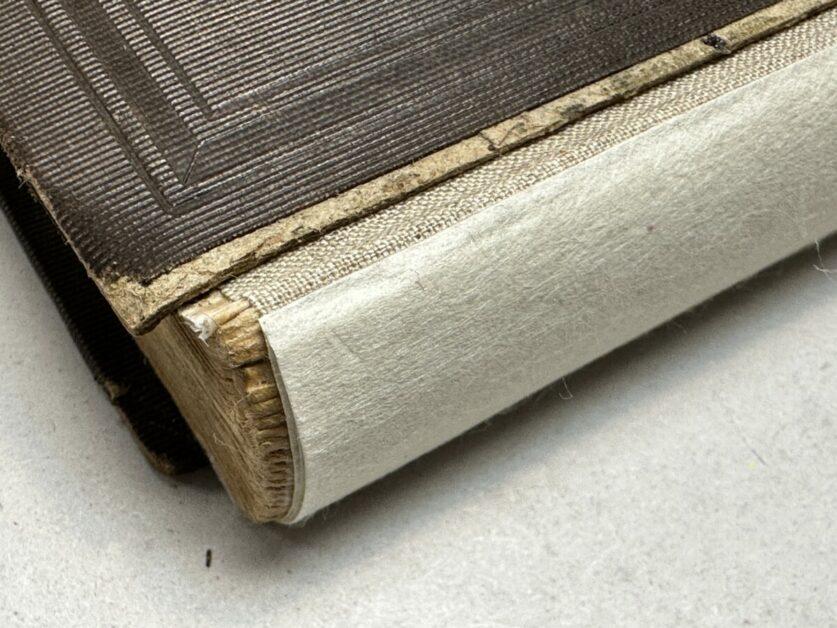
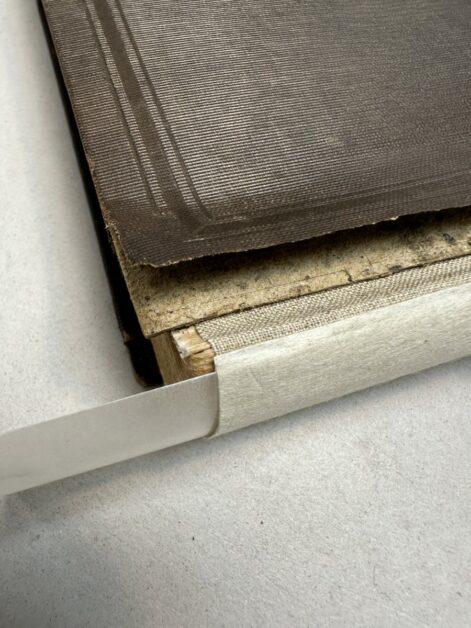
Text block spine with new starch adhesive and new backing paper reinforcement applied. Once this was complete I was able to apply new linen cloth backing to replace the damaged cloth, and a sturdy japanese paper hollow.

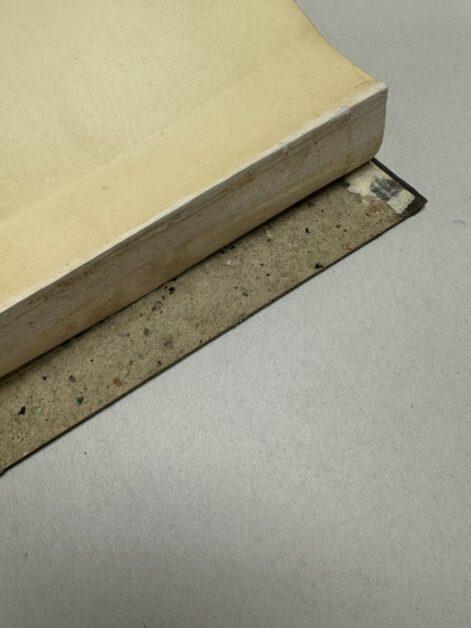
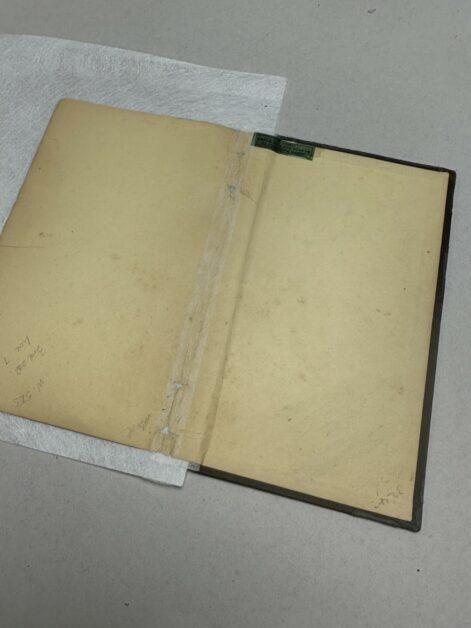
The cover boards were repaired, the damaged corners were mended and moriki paper was used to cover the areas that were missing the original bookcloth. The original endpapers could be mended and lifted from the boards to prepare for the insertion of the new backing fabric.

A close-up of a piece of wood

Description automatically generatedAn open book with a green label

Description automatically generatedA close-up of a book

Description automatically generatedA close-up of a book

Description automatically generatedClose-up of a piece of wood

Description automatically generated

A book with a white cover

Description automatically generated

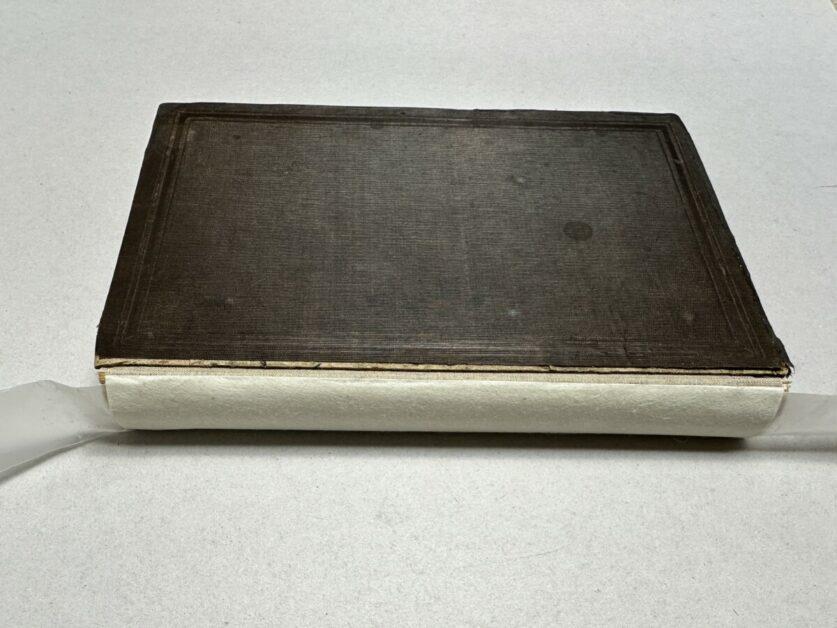
Once the cover was rebuilt, the spine cleaned and rebacked, and the endsheets repaired, I was able to attach the original covers back onto the text block. With the original cover cloth lifted, I inserted a replacement spine exterior made from linen backed toned moriki paper that I was able to then further tone with additional pigments to closely match the color of the original cover material. Once this spine repair was completed and the restored book pressed, this special historical book, Letters from New York, is ready to be returned to the shelf, to be accessed and utilized by future historians, researchers and the curious reader.

A close-up of a book

Description automatically generatedAn open book with a few pages

Description automatically generated


Friday, March 19, 2021

Building a Post Binder for a 19th Century Sewing Book

Sewing Book
Models with Instructions
used by
State Normal and Industrial School
Greensboro
N.C.
1895-1896

State Normal and Industrial School (now UNC Greensboro) once offered sewing classes for the young women attending the school. Along with preparing students to be teachers, the school's Domestic Science Department was also concerned with fostering the skills necessary for women to become good wives and mothers. No doubt sewing could be a useful skill to have during the early 20th century. The Martha Blakeney Hodges Special Collections and University Archives (SCUA) is fortunate to have three of these sewing books created by students in the late 19th century. 

Three examples of sewing models sewn by hand in 1895-1896

The three sewing books were delivered to Preservation Services so that we might devise a way to keep the pages as intact as possible while also stabilizing them. The goal is for these books to be used with classes visiting SCUA. Unfortunately, the substrate pages of the albums are quite discolored and brittle due to the acidity of the paper. Nonetheless, the sewing samples are incredibly intricate and interesting, especially considering they were all sewn by hand. Though there was not much we could do in house about the condition of the substrate pages, we were able to create post binders to better protect them. We also elected to leave the metal fasteners and pins that were securing the sewing samples to the pages because the pages were too brittle to remove them.

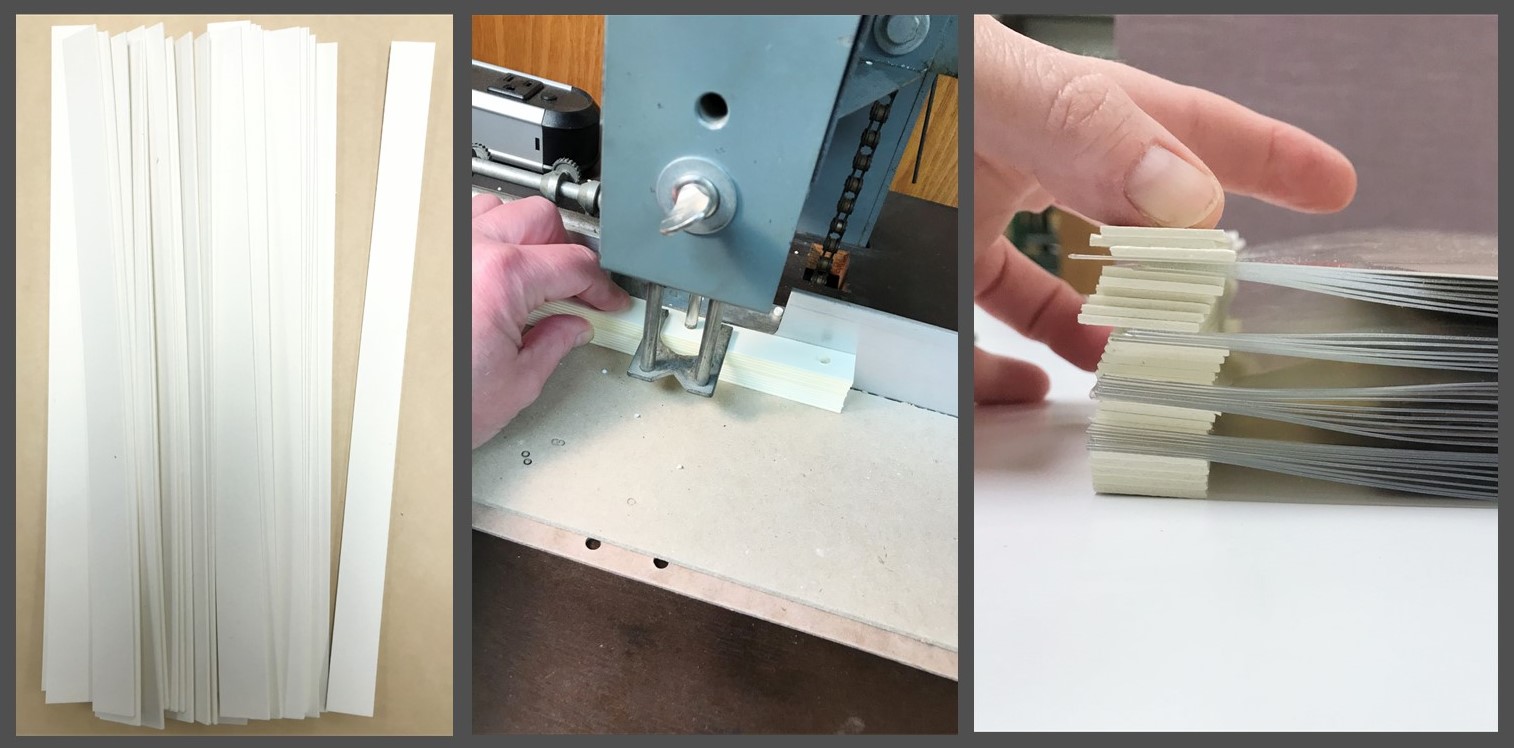
Left: Spacers cut from museum board, Center: Drilling holes with
the drill press, and Right: A preview of the spacers between the pages
Often, paper manufactured in the late 19th and early 20th century was created from wood pulp. The lignin, an organic substance that makes the cell walls in plants rigid or woody, in wood pulp contains acid that degrades the paper over time. You may have heard of the “Brittle Book Era”, which refers to this time period when paper manufacturers were under pressure to create a large quantity of paper very cheaply in order to meet the demand of the publishing industry. The wood pulp was cheaper to process into paper but resulted in very brittle paper over time. When brittle paper is torn, or more accurately “broken”, it is difficult to mend as the mend ends up being stronger than the paper being repaired and it simply breaks again along the edge of the mend. There are processes for deacidifying paper, such as washing it to remove some of the impurities and adjust the pH to a more neutral level, or spraying it with an alkaline solution to slow down the process of aging. However, there are often conservation solutions that simply are not feasible for us due to the cost or labor involved. Thus, creating post binders was the right solution for us at this time.

The assembled post binder
The sewing books’ pages were already loose and simply resting inside the sewing album covers, so disbinding was not necessary. The first step of stabilizing the pages was to put each page in a protective Mylar sleeve. This type of sleeve is often referred to as an L-sleeve because the edges are sealed along two sides in an L shape. They serve as a protective barrier both for the item inside the sleeve as well as anything it might come into contact with, such as neighboring sewing samples in this case. Once all the pages were sleeved, the next step was to drill holes near the spine edge so that the posts could be inserted through the covers and the block of pages. However, due to the thickness of the sewing samples, spacers were needed at the spine edge between some of the pages or else the spine would be much narrower than the pages which would result in a wedge shaped book that bulges open at the fore edge. Spacers of museum board (similar to mat board)  were cut to the height of the text block and drilled with a drill press (see pictures). The Mylar pages were also drilled based on the same template so that the holes will align when the binder is assembled. Custom covers were made in three pieces - a spine piece and two covers. The covers also had to be drilled. Once all the parts were prepared, the post binding was actually quite simple to assemble. The screw posts come in a variety of lengths so they can be fit to any thickness of textblock.

Additional views of the assembled post binder
Though it is common to have an extra allowance of space on the spine edge of the Mylar so that the pages can turn, these sleeves were left even larger so that the sewing book pages would not have to flex as much. The original stamped cover designs of the sewing books were removed and adhered to the front of the new post binders. Because the sleeves are not sealed along the top edge at the head of each book, custom-fitted clamshells were later built to house the binders to prevent them from collecting dust.

An open view of the post binder
The post binders are a versatile option for protecting the pages of a book. In this case, they may not be the perfect solution, but they have succeeded in stabilizing the pages and making them a bit safer to handle with a class of students. Ultimately, that is usually our goal - to preserve items for use with researchers, classes of students, and perhaps in exhibitions. 


Wednesday, February 17, 2021

Too Much Mending, Too Little Time

L: Bound cello music score, R: Detail of damaged cover

This 1917 volume of bound scores, from the collection of Luigi Silva (1903-1961), is part of the Cello Music Collection in the Martha Blakeney Hodges Special Collections and University Archives at UNC Greensboro. It is part of a set of several works bound together under the handwritten title Pezzi repertorio II (Repertoire Pieces II). This volume contains parts for a violin or violoncello and piano. The score also contains handwritten performance notes by Luigi Silva. Silva was a renowned musician as well as a teacher and scholar of the violoncello. To learn more about Luigi Silva, please visit the Luigi Silva Musical Score Collection and Personal Papers.

Damage to the cover on left and to the pages on right
Often, when we receive a damaged item in Preservation Services, we do not know the exact cause of the damage. This score is one such example. The front cover had been punctured by a sharp object, which caused damage through the cover and into the first 20-25 pages of the bound score. Because so many pages had been damaged, it was going to be a time-consuming task to mend the same hole or loss on all of the 20 or so damaged pages. 

Mending this type of damage requires careful consideration of materials. Though the score is unlikely to be used in performance any longer, it was necessary to ensure that the mend would remain flexible as the pages are turned by researchers or perhaps when the book is shared with a class. Mending tissues are often selected based on the type, age, and condition of the paper being mended. For example, a very brittle paper mended with a thick piece of Japanese paper would simply break again next to the mend, as the mend would be stronger than the paper itself.

L: Hole as it appears on one of the first pages, vs.
R: Hole as it appears on the last damaged page
The paper in this score was relatively stable in condition, so brittleness was not a concern. However, adding a Japanese tissue mend to each of the 20 or so damaged pages would quickly build up thickness in that one area that could be problematic in the function of the book. For that reason, a thin Japanese paper was used along with rice starch paste to mend each of the holes.

Another consideration in completing this type of mending is how much time is involved. Often in Preservation Services, we are able to go beyond basic repair and even restore a damaged item to close to its original condition. However, we must balance how and how often the item will be used in the future with how much time we can invest in its repair. Not every item warrants a full restoration.

L: The hole being repaired, R: Applying pasted tissue to the hole

In this case, the item may be used in the future by researchers, in a class, or in an exhibition, so it was necessary to spend more time in the conservation process rather than simply providing a protective enclosure for storage. To that end, in projects such as this one it becomes necessary to save time whenever possible as there are so many conservation projects in the queue. Not only do we conserve items in Special Collections and University Archives, but we are also tasked with preserving materials in the general circulating collections of Jackson Library as well as those in the Harold Schiffman Music Library on campus.

When time and space are not as much of a concern, or when working on a flat item such as a letterpress printed broadside, it would be common to allow each mend to dry under blotter and weight while working on another project at the same time. In the case of repairing this bound score, a quicker method was employed. A small travel iron on a very low heat setting was used to quickly dry each mend before moving on to the next one. So, mending more than 20 pages took a fraction of the time it might have. Applying heat is not always ideal, so the conservator must consider the type of materials being mended and what impact heat may have on the item.

L: Ironing mend to dry it quickly, R: Finished mend

For each mend, a substrate is placed under the page being mended. It consists of a piece of release paper (like parchment paper you might use in baking), which is layered over a cotton blotter on top of a scrap of book board. Rice starch paste is applied to a thin piece of Japanese paper torn to size and applied to the area of the page needing repair. A Teflon folder is used to press and smooth the tissue onto the paper being mended. Then, another piece of release paper is layered on top of the mend and the iron is used to apply heat to quickly dry the paste. The blotter underneath helps to absorb the moisture from the paste. In this way, 20 or more pages can be mended in a fraction of the time. Likewise, because a very thin tissue was used, the "stack" of mends did not build up into a thickness that might have impeded the cover from closing completely. So, the problem of too many mends and too little time was easily resolved.

As you see pictured below, the cover was also mended with a black Japanese paper. Two years ago, we posted another blog entry about mending the corner of a cello music score much like this one. Please click HERE to read about that repair.

Detail of repaired cover


Wednesday, June 13, 2018

Restoration of a Collection of String Quartet Compositions

Prioritizing our work can be challenging as we provide services to the general circulating collection in Walter Clinton Jackson Library, the collections of the Harold Schiffman Music Library, as well as the various collections of the Martha Blakeney Hodges Special Collections and University Archives. Part of our consideration of how to devote our time depends on how an item will be used, such as in an exhibition, with a class, or for a scheduled researcher appointment. The curator of each collection makes those decisions and the work falls into our work queue according to how soon it will be needed and for what purpose it will be used.

The cello music collections at UNCG constitute the largest single holding of archival cello music-related materials in the world. Stacey Krim manages the collection. One of her many duties is identifying items needing conservation and/or restoration (what's the difference?) so that they may be used by researchers or in classes, stabilized for storage, or handled for digitization purposes. 

Four volumes before treatment

This set of four volumes was bound by one of its previous owners and contains the instrumental parts for a variety of string quartet compositions written by variety of composers and published by different publishing houses between 1780 and 1809. The set was donated to the UNCG Cello Music Collection as part of the Bernard Greenhouse Collection. Krim identified the items as a priority for conservation and transferred them to Preservation Services. We determined that due to their intended use with classes and researchers, both repair and restoration would be necessary.

Left to Right: Quarter Leather, Half Leather, and Full Leather Bindings

The binding style of these four volumes is referred to as half leather. A book with all leather or all book cloth as its covering material is referred to as full leather or full cloth respectively. A book with leather or cloth at the spine and fore edge corners (or sometimes there is a strip of leather or cloth all along the fore edge instead of just at the corners) with an alternate material for the rest of the cover is half leather or half cloth. And, a book with leather or cloth just at the spine with a different material, such as cloth or paper, covering the remainder of the book is referred to as quarter leather or quarter cloth. Quarter and Half bindings were developed as a way to minimize use of the more expensive binding materials by covering the rest of the book cover in a more economical material such as cloth or paper.

Bound volumes with missing or detached spines

Three of the bound music scores were missing the spine all together and one book had a detached spine. The leather at the spines and fore edge corners was dry and brittle. In some cases, the leather had worn away to reveal the book board underneath. 

Tail edge of damaged volume before treatment

Mended pages during the treatment process


After restoration treatment

The paper sides, in this case blue paste paper, were also damaged and worn, particularly at the edges. The text block pages were in fairly good condition, but there were some tears and losses, including insect damage in a few places.

The interior pages were mended with Japanese paper and wheat starch paste. The covering material required several steps of treatment. The leather was treated with Klucel-G, a consolidant that also helps prevent the leather from burning (darkening) during the mending process as it is exposed to the moisture of the paste.
 
Worn leather fore edge corner with damaged board underneath

Rebuilding the board with linen cord remnants and adhesive

The book board was consolidated as well, and in some cases it was rebuilt where it was too damaged or was missing parts. 

During treatment - Japanese paper applied, then toned to match

After treatment - corners fully restored

Toned Japanese paper was applied over the exposed book board and then further toned with watercolor to more closely resemble the original covering material of either leather or paste paper. A coat of Klucel-G was applied over the newly attached Japanese paper and watercolor to further seal and protect the Japanese paper and to match the sheen of the original leather.

Spines during treatment

Spine reattached and secured with toned Japanese paper

The new spines were created with Japanese paper laminated to Irish linen to lend strength, then attached to the books. The one remaining original spine was reattached over the laminated Japanese paper and Irish linen.

Four volumes after treatment

Not all of the books we treat receive full restoration such as these. For example, the priority for a book in the generally circulating collection is to return it to service quickly having been repaired in a method that can withstand the use of many patrons over a long period of time. Though we make every effort to create a tidy, attractive repair, the priority is the strength and speed of the repair. Though the restoration of the four volumes of cello music provides a functional and aesthetically pleasing solution, it required a much more time-consuming process and is perhaps not capable of receiving the regular handling as a book in the general collection.

Nonetheless, it is a treat for us to do restoration work as it is a change of pace and often provides such satisfying results, though more challenging work to do.