Tuesday, March 17, 2026

Algonquin Legends of New England by Charles Leland

 by Audrey Sage

Algonquin Legends of New England by Charles Godfrey Leland is a collection of myths and folklore derived from the Micmac, Passamaquoddy, and Penobscot tribes, recorded during the late 19th century. The work aims to preserve the rich cultural heritage of these Northeastern Algonquin tribes by compiling and narrating their ancient tales, which explore themes of creation, morality, and the relationship between humanity and the divine.

The collection presented in the book is a result of the collecting efforts of folklorist Charles G. Leland and Rev. Silas T. Rand, a Canadian Baptist clergyman who was the first to record these legends from Indian narrators and highlight the complexity and antiquity of their mythology. The particular legend of Glooskap takes up the majority of the book.

Leland outlines the main figure, Glooskap, a demigod representing the good principle, and his evil twin, Malsum, or the Wolf. As the narrative unfolds, it reveals Glooskap's benevolent deeds, such as creating humans and animals, while also suggesting a parallel between these legends and Norse mythology. The opening sets the stage for a captivating exploration of folklore that weaves together elements of the natural world with the spiritual beliefs of these indigenous cultures, inviting readers to delve into a world rich in storytelling and tradition. — Notes from Project Gutenburg and Public Domain Review

This central character, Glooskap, "grows to a more appalling greatness than Thor or Odin in his battles," and whose name literally means Liar, because it is said that when he left earth he promised to return but has never done so. In addition to Glooskap, a large proportion of the book is dedicated to "The Merry Tales of Lox, the Mischief-Maker", a character, as Leland explains in his introduction, who ranges "from Punch to Satan, passing through the stages of an Indian Mephistopheles and the Norse Loki, who appears to have been his true progenitor". Also, throughout the book are scattered a set of wonderful illustrations , presumably copied from tribe members themselves, though no information is given on this. - Public Domain Review


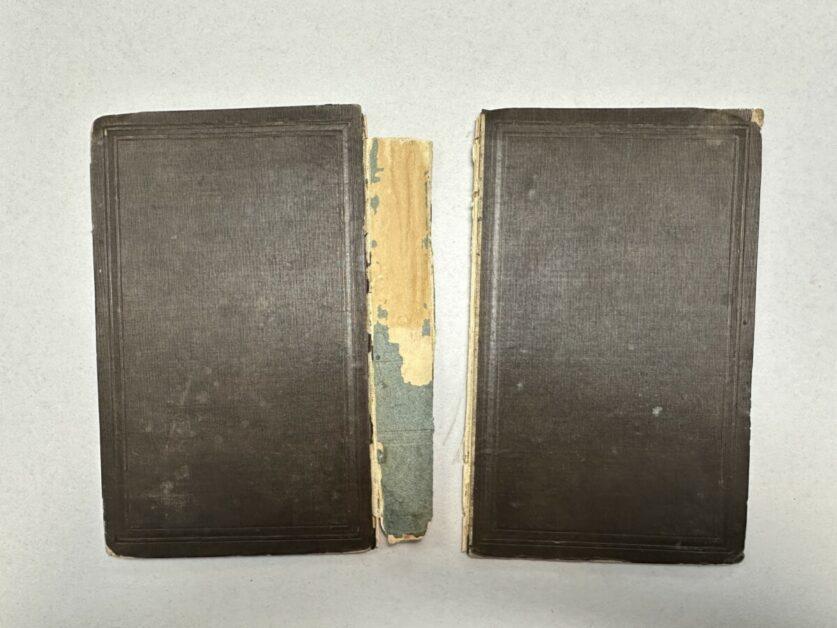
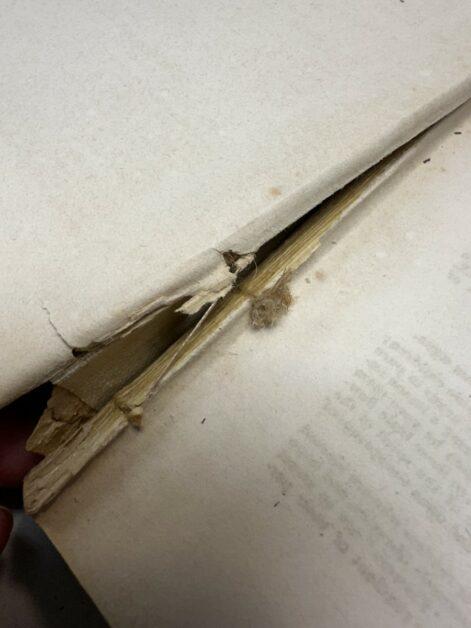
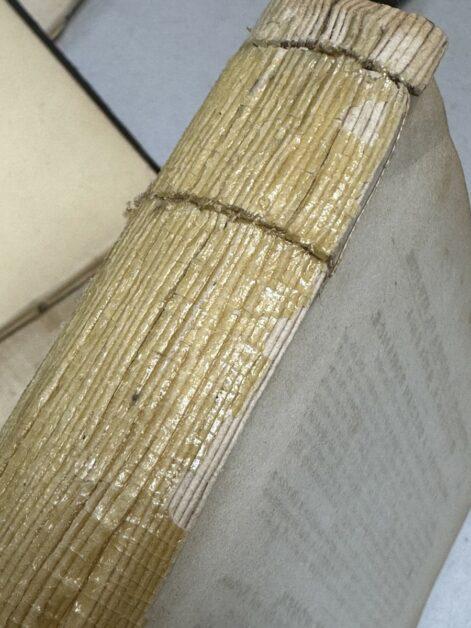
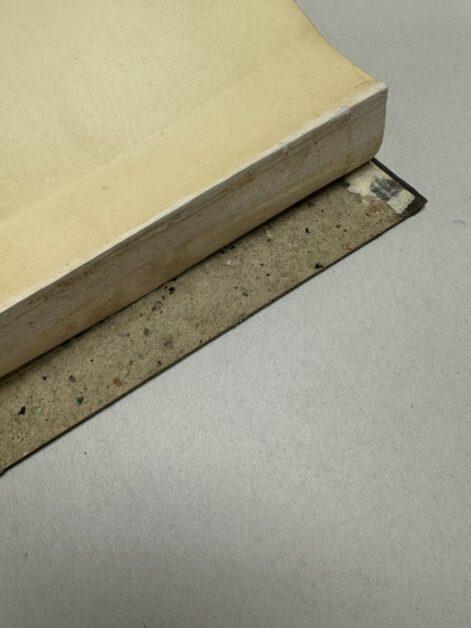
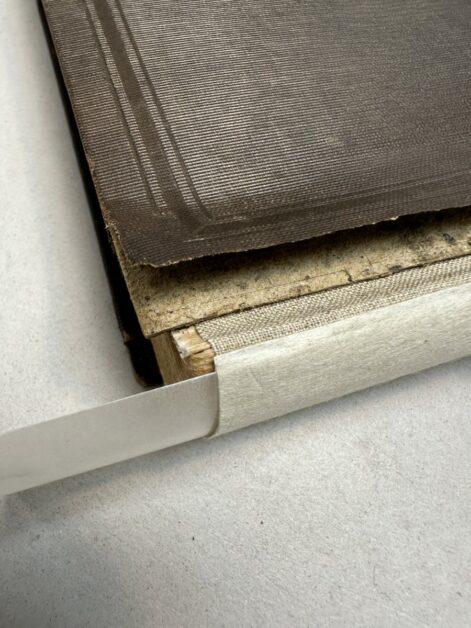
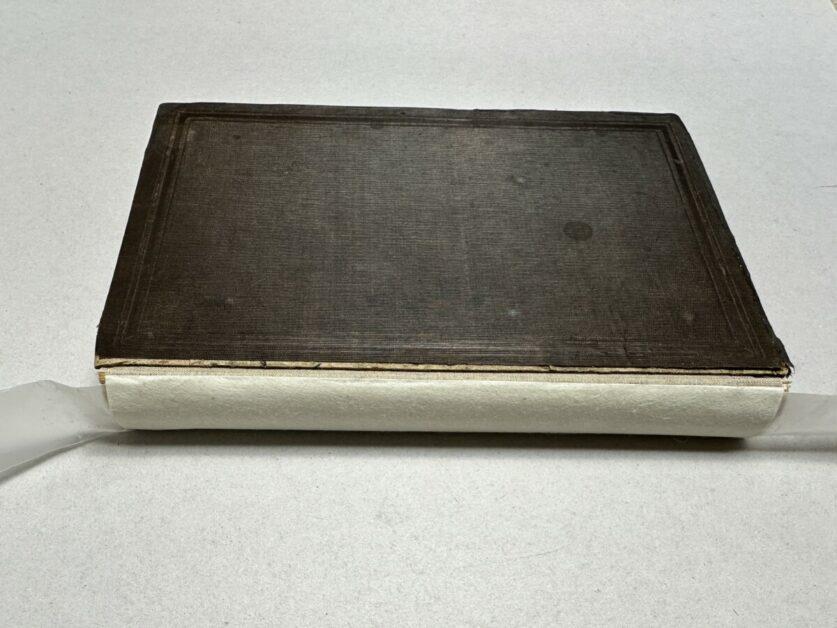
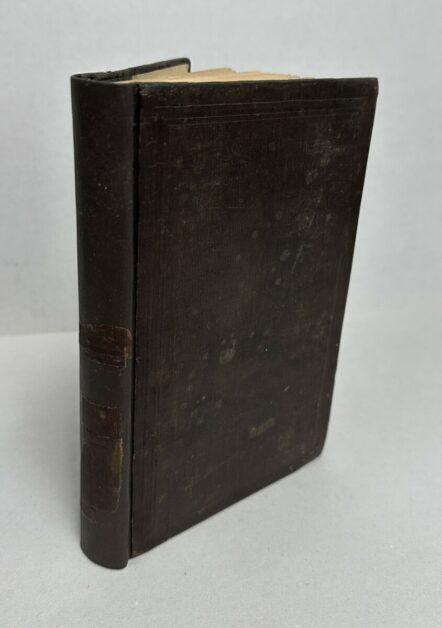
The University Libraries received a copy of Algonquin Legends of New England from a kind donor. As you can see, it had suffered much damage, from wear and tear, animal chewing, insect activity, and time. The original construction included a textblock construction technique that involved stapling through the fold of the signature (a gathering of folded pages) into the backing material, instead of the more traditional sewing of signatures together, first, to form the text block, then applying the cloth backing to the spine. The quality of the metal staples was inferior, as can be seen, and they had rusted which degraded the paper and the cloth.

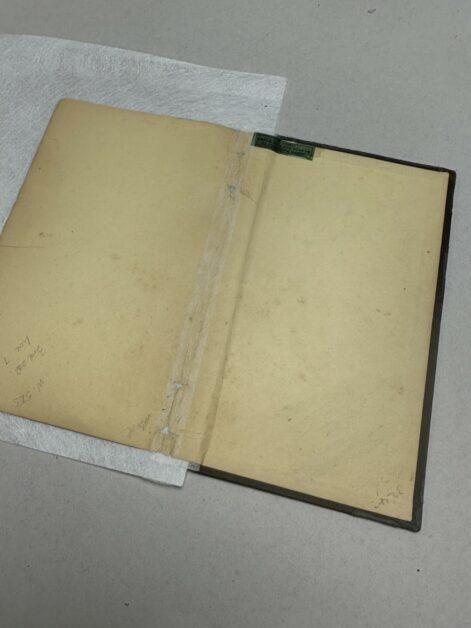
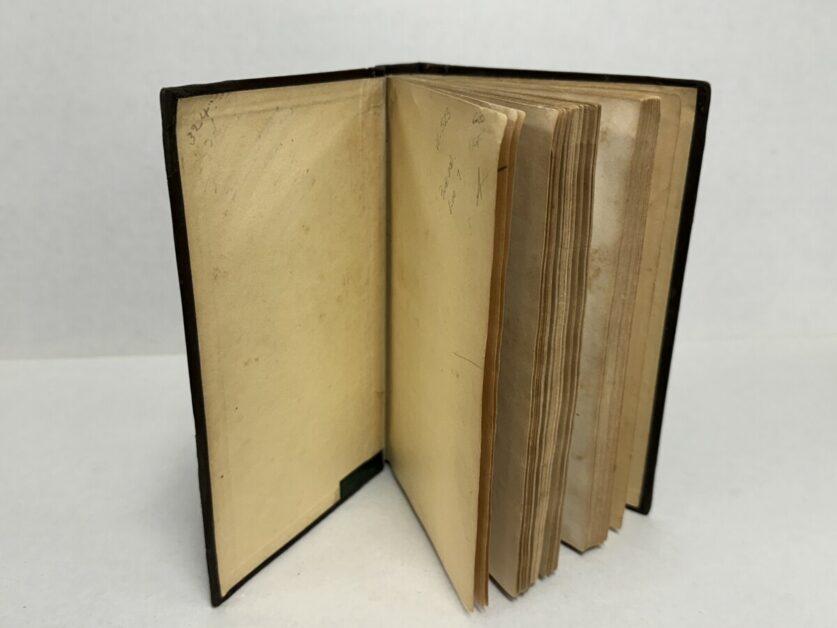
From various usage and ownership, the endpapers suffered abuse.

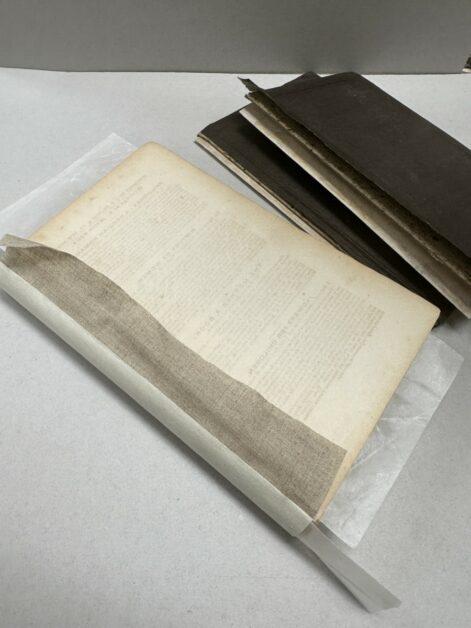
The book was taken apart, the staples removed, and any necessary paper mends along the folds were performed.

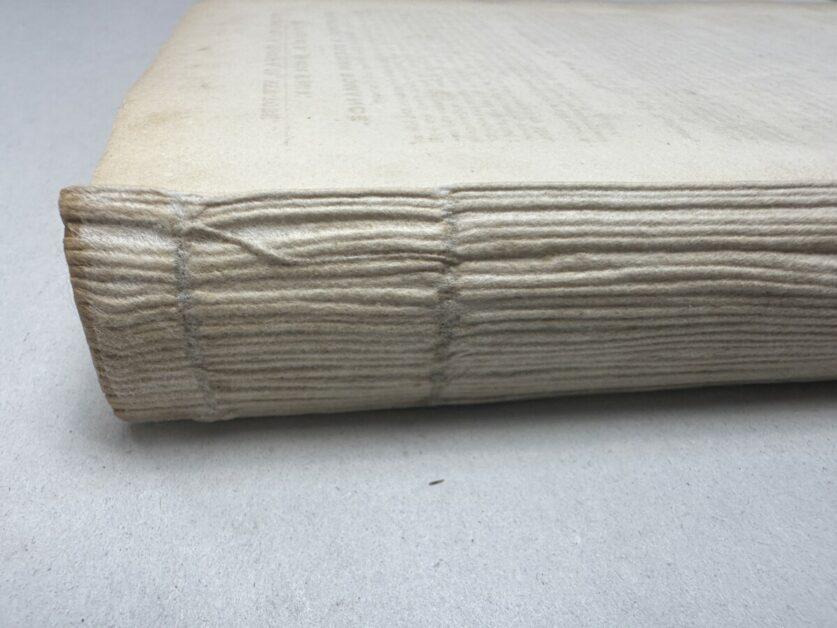
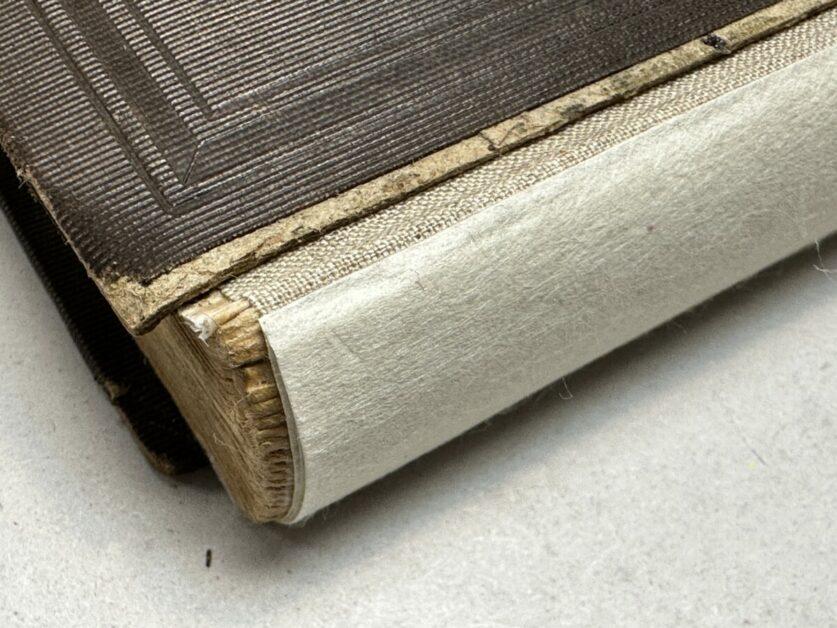
The signatures were sewn together using the linked stitch pattern. New backing cloth, a japanese paper hollow, and new endpapers, similar to the original color and of archival quality were all attached.

Once the textblock was rebuilt, attention was then given to the damaged cover. Pigment was applied to the areas where the original coating had been eaten away.

The original cloth was lifted and a new mending cloth was inserted. After a protective coating of Klucel G was applied, the textblock was then reinserted into the cover.

The book has now become much more attractive and functional.
Friday, September 6, 2024

 The Restoration of Letters from New York

by Audrey Sage


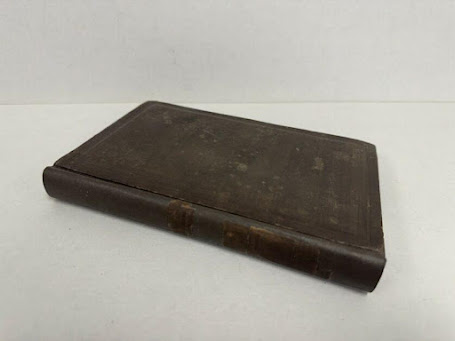
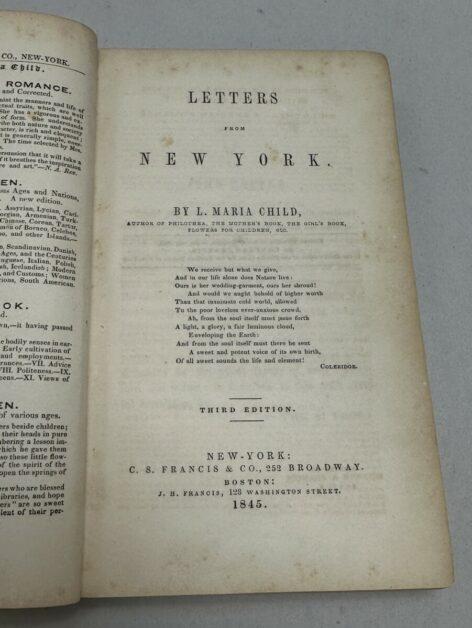
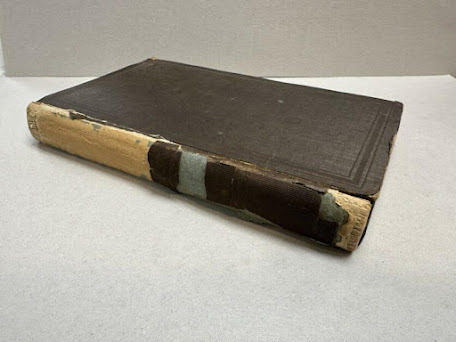
The Special Collections contains a copy of Letters from New York by L. Maria Child, which was published in 1845 by C. S. Frances & Co. in New York. Other works by L. Maria Child include Philothea: A Grecian Romance, History of Women, The Mother's Book, and Flowers for Children.

A book with a brown cover

Description automatically generated with medium confidence
Before restoration
A book with a leather cover

Description automatically generated
After restoration

An open book with text on it

Description automatically generated
Prominent author and abolitionist Lydia Maria Child began writing her "letters" from New York in August 1841 as a response to the troubling realities marking her private and public life. In particular, she was preoccupied by her editorial duties at the National Anti-Slavery Standard and dismayed by the growing sectarian spirit of antislavery reform. Collected primarily from the pages of the Standard, her literary essays on women's rights, the preaching of African American minister Julia Pell, the Crosby Street Synagogue, animal magnetism, the engineering miracle of Croton Aqueduct, and countless other people, topics, and events capture the breathless and sometimes unsettling transformation of one representative hub of national life. - University of Georgia PressA close up of a book

Description automatically generatedA close up of a book

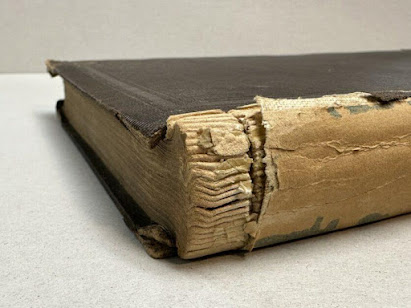
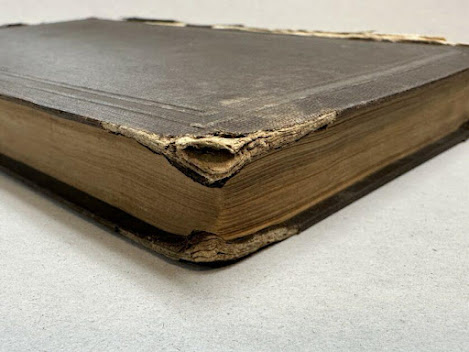
Description automatically generatedThis third edition of "Letters from New York" had become worn and in need of restoration treatment. I began the work by removing the covers from the text block in order to perform the mends necessary before I would be able to rebuild the cover. A broken book with a hole in it

Description automatically generated


The text block signatures were somewhat loose due to the poor condition of the original adhesives, as well as the unfortunate tearing of the backing cloth. 

A close up of a book

Description automatically generatedA close-up of a book

Description automatically generated

I was able to remove the old glue and apply new starch adhesive and archival mending tissue to reinforce the spine, salvaging the original sewing.

A close-up of a book

Description automatically generated

Text block spine with new starch adhesive and new backing paper reinforcement applied. Once this was complete I was able to apply new linen cloth backing to replace the damaged cloth, and a sturdy japanese paper hollow.

The cover boards were repaired, the damaged corners were mended and moriki paper was used to cover the areas that were missing the original bookcloth. The original endpapers could be mended and lifted from the boards to prepare for the insertion of the new backing fabric.

A close-up of a piece of wood

Description automatically generatedAn open book with a green label

Description automatically generatedA close-up of a book

Description automatically generatedA close-up of a book

Description automatically generatedClose-up of a piece of wood

Description automatically generated

A book with a white cover

Description automatically generated

Once the cover was rebuilt, the spine cleaned and rebacked, and the endsheets repaired, I was able to attach the original covers back onto the text block. With the original cover cloth lifted, I inserted a replacement spine exterior made from linen backed toned moriki paper that I was able to then further tone with additional pigments to closely match the color of the original cover material. Once this spine repair was completed and the restored book pressed, this special historical book, Letters from New York, is ready to be returned to the shelf, to be accessed and utilized by future historians, researchers and the curious reader.

A close-up of a book

Description automatically generatedAn open book with a few pages

Description automatically generated


Thursday, March 2, 2023

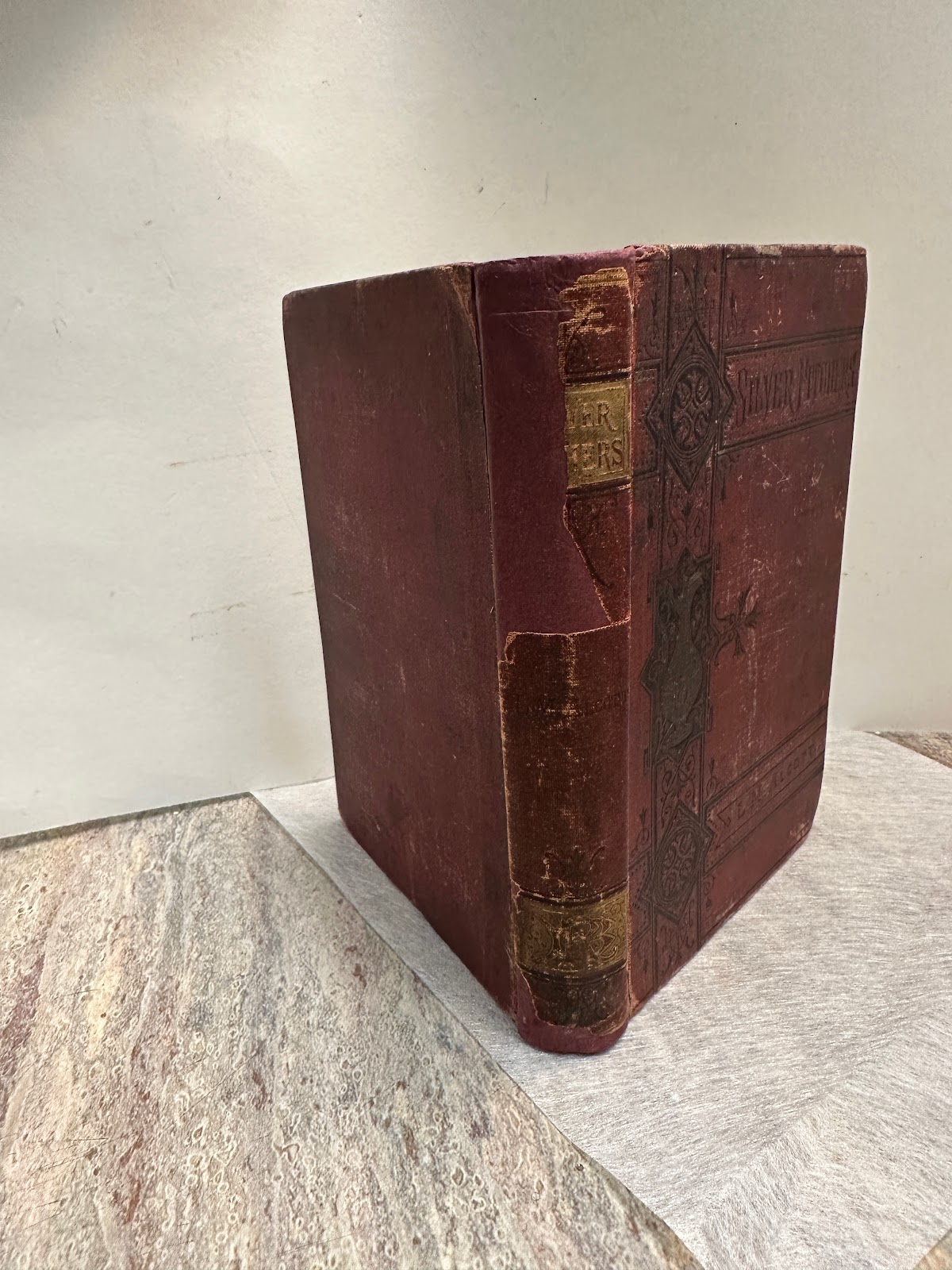
Silver Pitchers: and Independence, a Centennial Love Story - a collection of short stories by Louisa May Alcott


Special Collections and University Archives received a wonderful gift from Judith Fetterley, a first edition copy of Silver Pitchers: and Independence, a Centennial Love Story by Louisa May Alcott published by Roberts Brothers in Boston, 1876.

Conservator Audrey Sage was able to put a plan into action to provide some repair and restoration to this wonderful book. Part of the original spine was missing and the original text block spine adhesive was failing leaving the text block at risk for damage and deterioration.  


 The  first step was to carefully remove the remaining spine adhesive. This was able to be accessed due to the damage of the cover cloth.  Once the old adhesive was removed, I was able to apply a layer of new starch paste and a protective piece of 18 gram Kozo Japanese paper.  This creates a strong and supportive layer for the textlbock signatures.  The next action was to create a paper hollow along the spine.


Sage was then able to carefully lift the original cloth from the cover boards in order to insert a new spine substrate to recreate and reform the cloth covering.  This piece is constructed through the lamination of a layer of linen cloth and a toned piece of Moriki Japanese paper. 


This new spine piece was inserted and formed around the book and then what remained of the original spine was adhered to this piece. 


Damaged corners were repaired, pages were surface cleaned, interior hinges were mended, and finally the book is ready to be returned to the Special Collections.  It is now more secure and easier to use and view with these archival mends in place.

Wednesday, June 22, 2022

The Intriguing World of Lois Morrison - Book Artist

 Lois Morrison, an artist specializing in cloth-wood artifacts and quilts, was born of missionary parents on February 1, 1934 in Zaire, once known as the Belgian Congo. Until she was 18, they travelled back and forth between there and Richmond, Virginia. She completed her BA degree at Mary Baldwin College, Staunton, Virginia. She went on to graduate work (1956-1963) at Indiana University, Bloomington, Indiana. In 1965, she took her MFA degree from Virginia Commonwealth University, Richmond, Virginia.  She returned to Mary Baldwin College as assistant Professor and taught there until she moved to Leonia, New Jersey in 1970. Morrison has conducted workshops, shown her work around the world and enjoys her travels to places near and far.


Lois Morrison at Lafayette College, 2011, teaching a book making course.

Her imaginative, contemplative, whimsical books are held in the collections of distinguished institutions such as Tate Gallery, London; The Cooper-Hewitt Museum, New York; and The Museum of Modern Art, San Francisco, Victoria and Albert Museum in London, the Getty Museum in Los Angeles, California, Yale University Library and the Chicago Art Institute, among others.

Morrison's work began with fabric, first with quilting then fabric books. In the 1980’s, a fortuitous request from a friend to “make me a book” led her on the journey to what has become a passion. She stated that “all work dwindled for this”. Twice a year she finishes a fabric book, making two - one for herself and one for sale. Later she began making paper books as a way of making her work more accessible since she can make an edition of 25. For these she uses a Gocco printer – a simple Japanese screen-based object that makes either postcard-sized prints or exactly double that.  Most of her books have a movable three-dimensional aspect.  She states that reading was her earliest joy, so to make books with her own hands – working with text, illustration, and form – is making her end game a joy – dreams made concrete.


The Mechanical Baby, 2000 


The Caterpillar Who Is a Corps De Ballet, 1994 

These works pictured above are held in the collection of Special Collections and University Archives, UNCG

Lois Morrison has collaborated with Julie Chen and Flying fish Press on many artistic creations.  They have been friends for over forty years, having met when Julie Chen was a teenager, dating Lois Morrison’s son. Chen stated that she was introduced to the world of art when she met Lois Morrison.  Visiting her home and surrounded by the art Morrison both created and housed as well as finding stacks of art magazines she was able to peruse, was eye-opening and inspirational. 


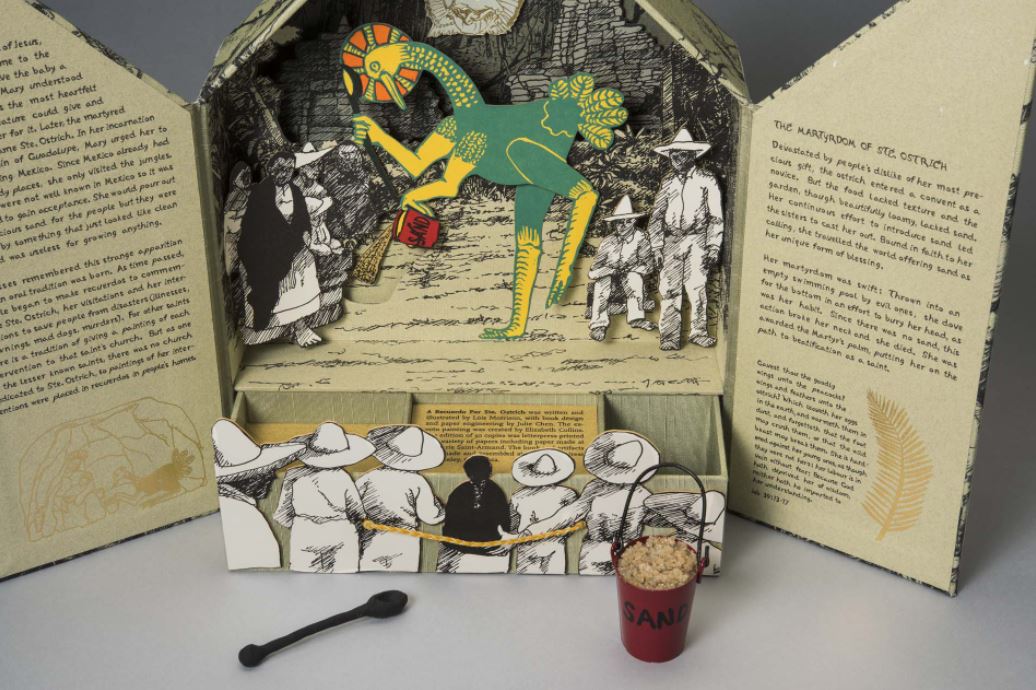
A Recuerdo for Ste. Ostrich, 2017. - Lois Morrison and Julie Chen, held in the collection of 
Special Collections and University Archives, UNCG

Their friendship and mutual respect for one another has led to several beautiful, unique and fascinating collaborations, two of which include Ste. Ostrich in Manhattan: The Visitations of a Martyr and this most recent work - A Recuerdo for Ste. Ostrich. Published in 2017, 27 years after the publication of Ste Ostrich in Manhattan, this book follows the fictional character of Ste Ostrich to Mexico, where "she continues to bestow her special blessing of sand on the bemused locals". Presented in the form of a house-shaped altar, complete with a movable Ste. Ostrich and a drawer containing miniature versions of her long-handled spoon and bucket of sand. Letterpress printed using photopolymer plates made from pen and ink drawings by Lois. The papers are handmade by Papeterie Saint-Armand in Montreal, Canada. The box has a magnetic closure and is covered with custom-printed book cloth designed by Lois.

Artist Book Ideation Cards


Morrison has used the Artist Book Ideation Cards developed by Julie Chen and Barbara Tetenbaum to initiate her creative thought process. For example, using the cards, Morrison’s color card directed her to use her ‘favorite color.’ Yellow became the defining theme for the resulting book Deep in the Yellow Woods, which contained characters from other Morrison works, but she says she did introduce a new character - the yellow dog. She then printed the book on three different shades of yellow paper with imagery of her yellow goat, featured in previous works and inspired by an old comic strip, 'The yellow kid.’


Deep in the Yellow Woods, 2015.

Morrison works in fabric and paper, but she also makes use of and is inspired by all sorts of objects she has found and salvaged which make delightful or sometimes foreboding appearances in her work—broken dolls, turkey feet discovered at a street market in Mexico, x-rays, small rocks, dead insects, pieces of metal, and, of course, bones. Morrison’s works are amusing, delightful, thought-provoking, and always highly engaging.

Each time I encounter work by Lois Morrison, I gratefully stop whatever I am doing, to sit and become immersed in the thoughts and creative vision she is conveying in the piece. I recently discovered the wonderful work in our collection - Spring in the Cabin. I opened the small box, and lifted out the handmade book, and in doing so, quite a number and variety of replicated dead insects fell onto the table. I couldn't help but laugh out loud. This work speaks of the discovery each year of the tiny carcasses found on windowsills and floors, the furtive and trapped little lives that succumbed to death. In the final thoughts of the book, the artist expressed her gratitude for these creatures as they provided her with something to draw.


Spring in the Cabin, 1993, held in the collection of Special Collections and University Archives, UNCG 


Fish: Whales are Not Fish, 1987, held in the collection of Special Collections and University Archives, UNCG 


Turkey Trot, 2007, held in the collection of Special Collections and University Archives, UNCG

There are so many wonderful pieces Lois Morrison has created. UNCG is fortunate to have quite a number in our collections and too many to focus upon for this short article, but I hope that if you have not encountered her work before, you may be inspired to discover more about her by my introduction.

-Audrey Sage