Showing posts with label special collections. Show all posts

Friday, September 6, 2024

 The Restoration of Letters from New York

by Audrey Sage


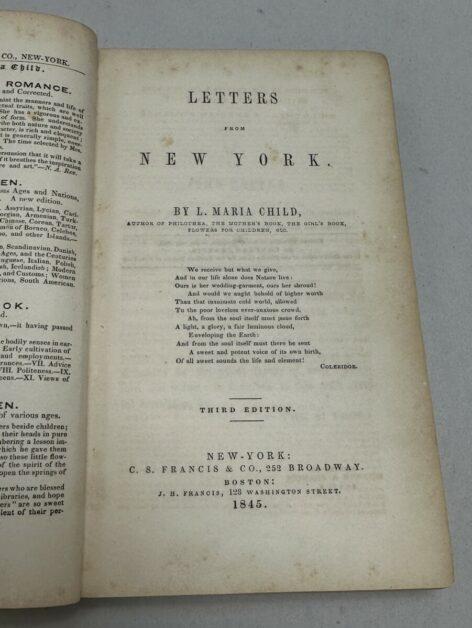
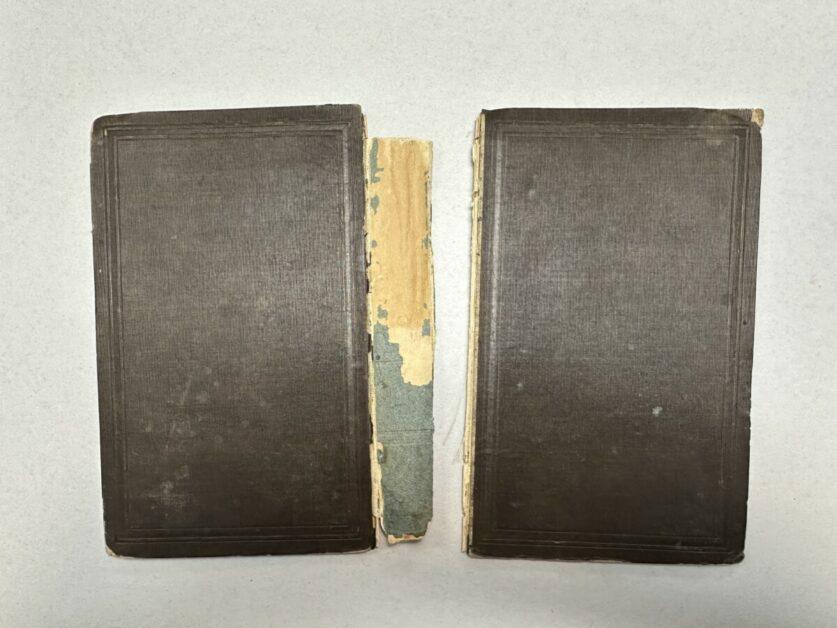
The Special Collections contains a copy of Letters from New York by L. Maria Child, which was published in 1845 by C. S. Frances & Co. in New York. Other works by L. Maria Child include Philothea: A Grecian Romance, History of Women, The Mother's Book, and Flowers for Children.
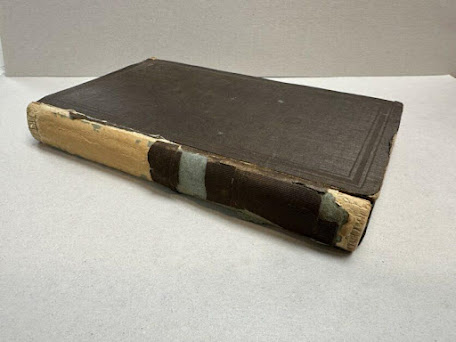
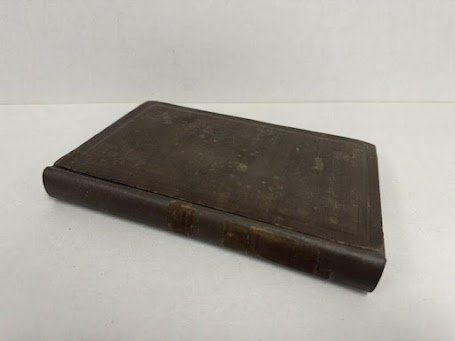
A book with a brown cover

Description automatically generated with medium confidence
Before restoration
A book with a leather cover

Description automatically generated
After restoration

An open book with text on it

Description automatically generated
Prominent author and abolitionist Lydia Maria Child began writing her "letters" from New York in August 1841 as a response to the troubling realities marking her private and public life. In particular, she was preoccupied by her editorial duties at the National Anti-Slavery Standard and dismayed by the growing sectarian spirit of antislavery reform. Collected primarily from the pages of the Standard, her literary essays on women's rights, the preaching of African American minister Julia Pell, the Crosby Street Synagogue, animal magnetism, the engineering miracle of Croton Aqueduct, and countless other people, topics, and events capture the breathless and sometimes unsettling transformation of one representative hub of national life. - University of Georgia PressA close up of a book

Description automatically generatedA close up of a book

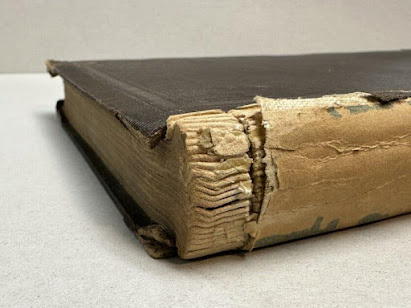
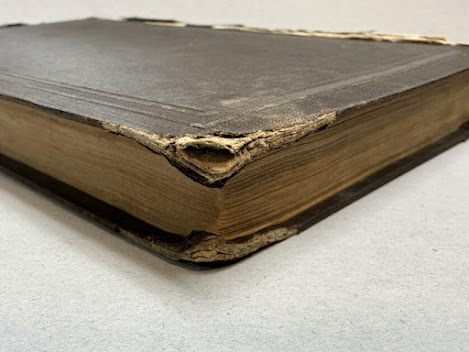
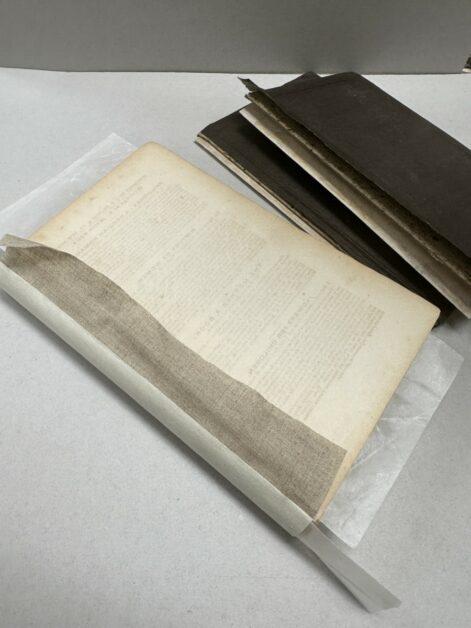
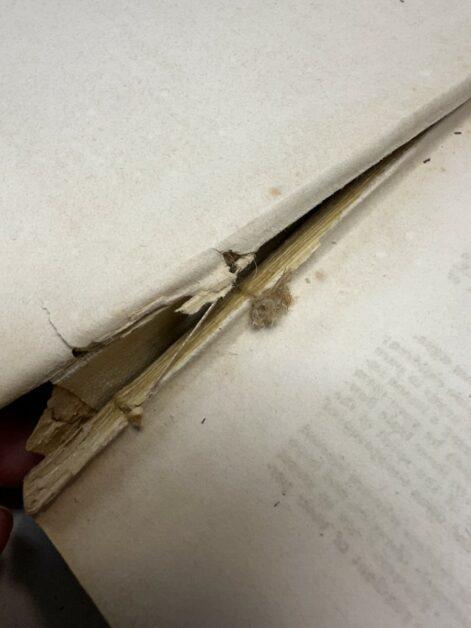
Description automatically generatedThis third edition of "Letters from New York" had become worn and in need of restoration treatment. I began the work by removing the covers from the text block in order to perform the mends necessary before I would be able to rebuild the cover. A broken book with a hole in it

Description automatically generated


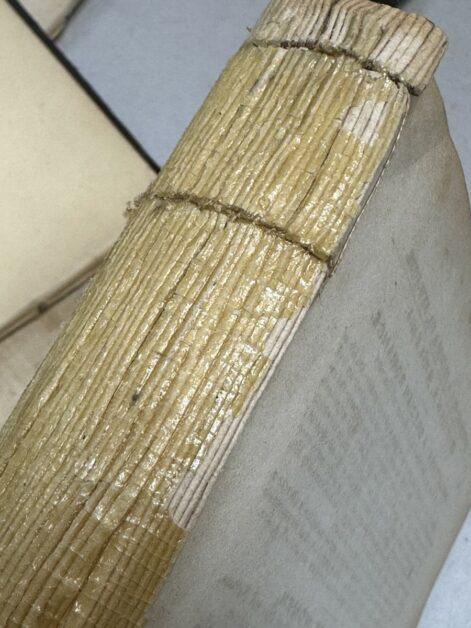
The text block signatures were somewhat loose due to the poor condition of the original adhesives, as well as the unfortunate tearing of the backing cloth. 
A close up of a book

Description automatically generatedA close-up of a book

Description automatically generated

I was able to remove the old glue and apply new starch adhesive and archival mending tissue to reinforce the spine, salvaging the original sewing.
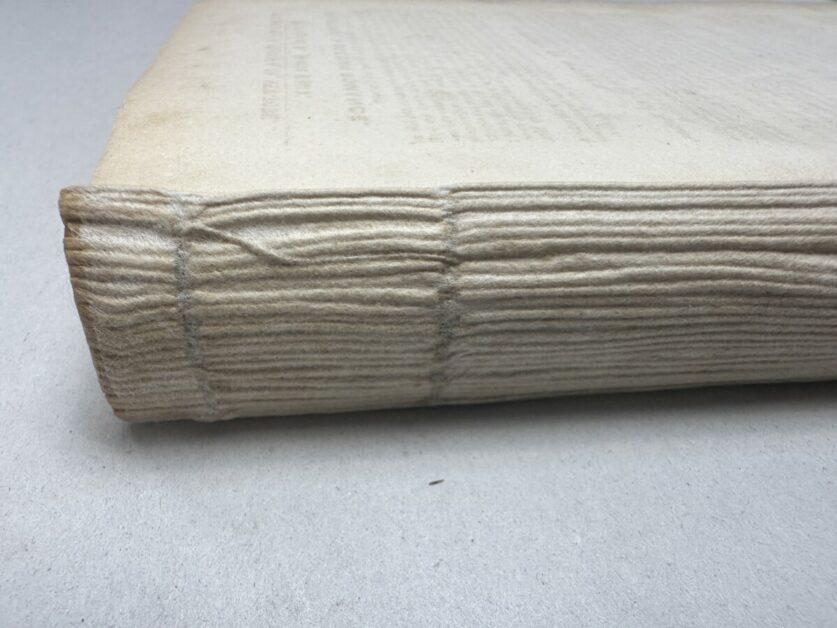
A close-up of a book

Description automatically generated

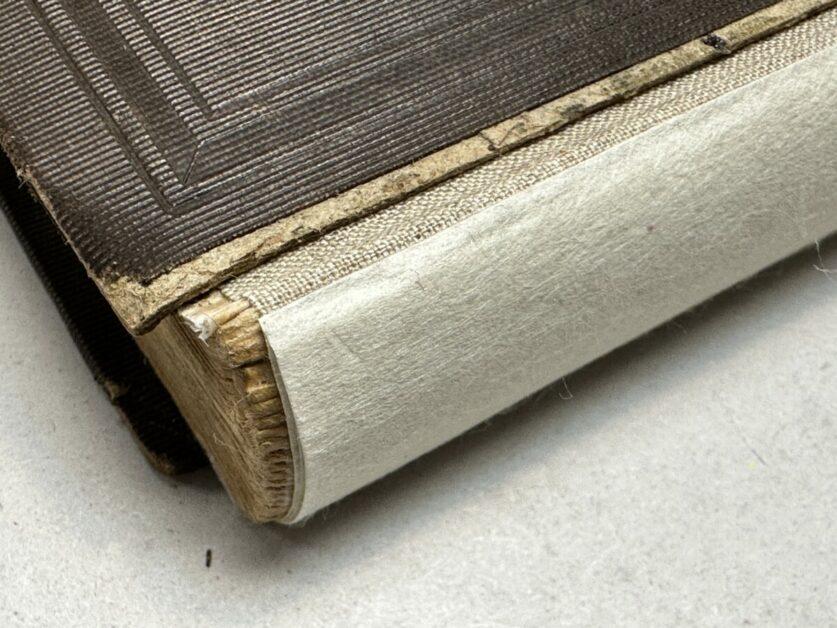
Text block spine with new starch adhesive and new backing paper reinforcement applied. Once this was complete I was able to apply new linen cloth backing to replace the damaged cloth, and a sturdy japanese paper hollow.

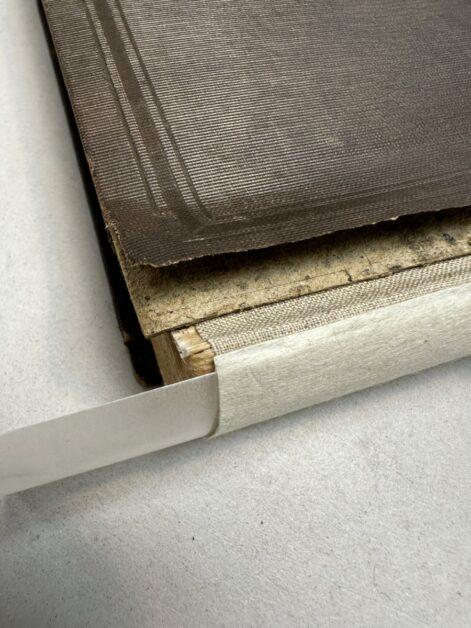
The cover boards were repaired, the damaged corners were mended and moriki paper was used to cover the areas that were missing the original bookcloth. The original endpapers could be mended and lifted from the boards to prepare for the insertion of the new backing fabric.
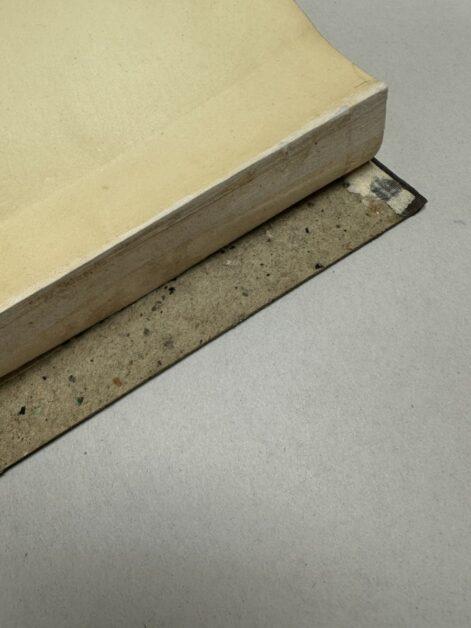
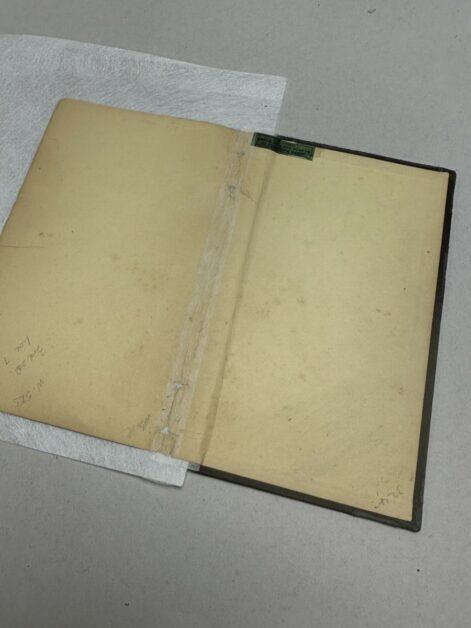
A close-up of a piece of wood

Description automatically generatedAn open book with a green label

Description automatically generatedA close-up of a book

Description automatically generatedA close-up of a book

Description automatically generatedClose-up of a piece of wood

Description automatically generated

A book with a white cover

Description automatically generated

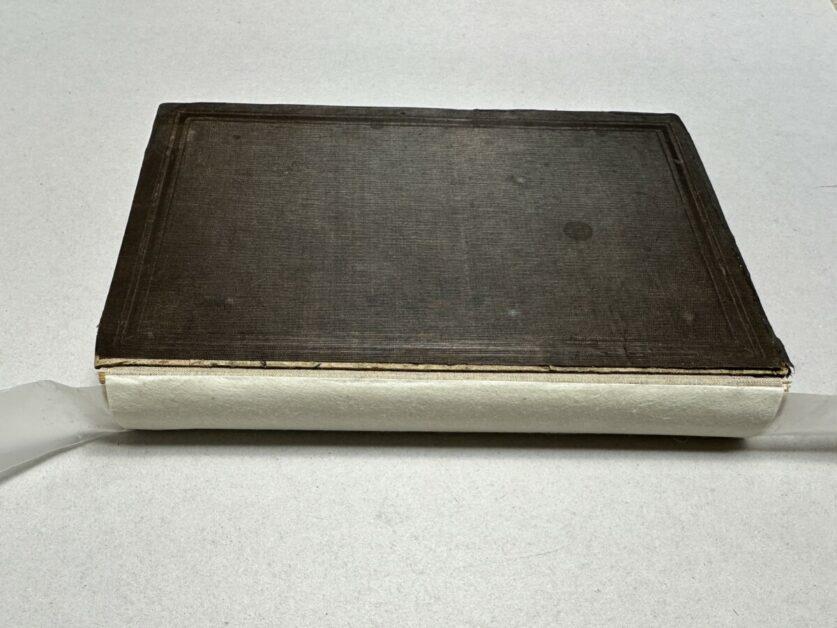
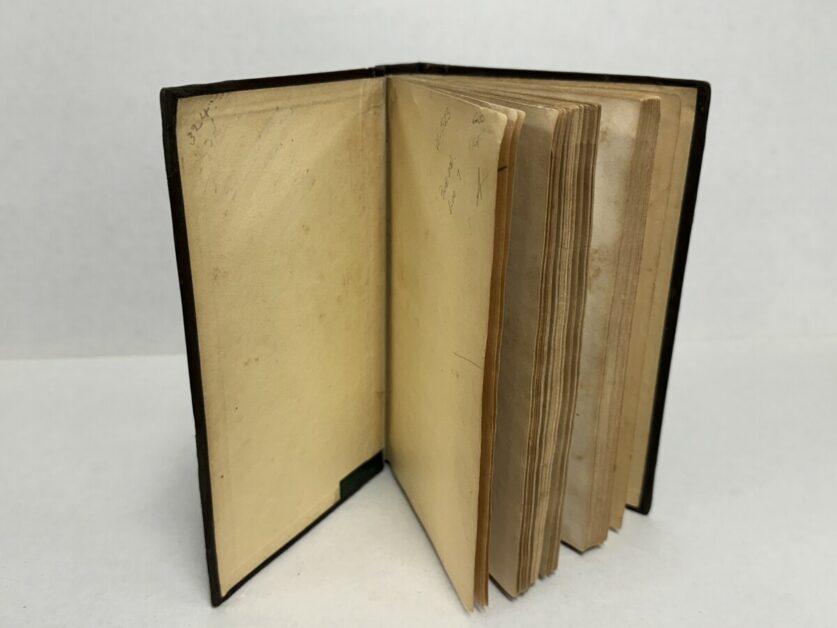
Once the cover was rebuilt, the spine cleaned and rebacked, and the endsheets repaired, I was able to attach the original covers back onto the text block. With the original cover cloth lifted, I inserted a replacement spine exterior made from linen backed toned moriki paper that I was able to then further tone with additional pigments to closely match the color of the original cover material. Once this spine repair was completed and the restored book pressed, this special historical book, Letters from New York, is ready to be returned to the shelf, to be accessed and utilized by future historians, researchers and the curious reader.
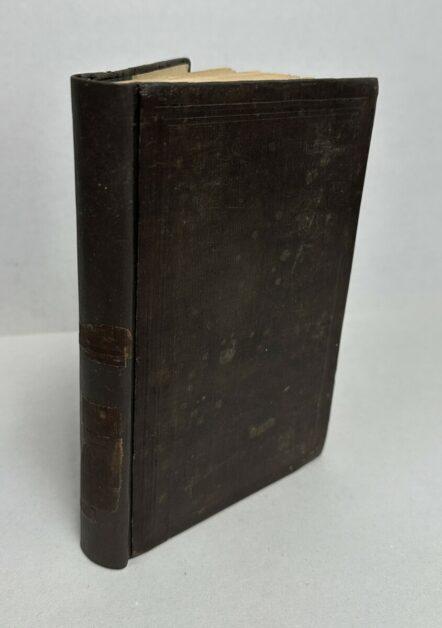
A close-up of a book

Description automatically generatedAn open book with a few pages

Description automatically generated


Tuesday, March 1, 2022

Wee Things in the Special Collections and University Archives and How to Contain them.


The Special Collections and University Archives continues to build their collections, strategically investing and acquiring significant, unique and interesting items.  These collections further the interest of the University as scholars, researchers and patrons seek discoverable information that furthers their knowledge and understanding of both the past and the future.  Occasionally, items acquired are in sizes that are less common.  We have recently acquired several very small items that presented us with an opportunity to construct thoughtful and intentional enclosures.  Many times, smaller items require a larger enclosure so it may claim it’s space on the shelf, and not be overshadowed or overwhelmed by its neighbors.

 I selected an interesting artist book titled “Trains” by Kathy and Gary Miller of Iron Bear Press to create a unique enclosure. The book measures 2.875” x 1.75” x .25”, that includes its own paper slipcover that is imprinted with images of railway lines.  It has beautiful polaroid photo transfers and is constructed in an accordion style format. The story speaks of memories of watching trains, counting cars and pressing pennies on the tracks, which resonated with me, as this is a very fond memory of my own, when visiting my grandmother’s house when I was young.  I designed a special clamshell enclosure for this small volume.  I created a drawer, into which the book can rest and remain secure, until it is retrieved for viewing. The overall dimensions of the enclosure are 6” x 9” x 1”.


Our manuscripts archivist, Stacey Krim, discovered an oversized match book while recently processing the Marjorie "Marge" Burns Papers. The question was raised regarding the safety of storing a potentially combustible item within a collection.  While researching options and opinions, she discovered one solution that was implemented at Smithsonian Institute Archives whereby a sink mat was created to surround the matchbook and enclosed with mylar.  I decided to create a similar enclosure.  By utilizing the mylar, any potential friction would be minimized, thus limiting combustion of the match heads, although there is the theory that in many cases, match books of this age are most likely inert.  This item will be stored in a file, so I created a two-sided mat, wherein both sides of the match book are visible. On one side of the construction, the Mylar is tucked under the corrugated board, allowing it to be lifted, if there is need to temporarily remove the match book.


Beth Ann Koelsch, curator for the Women Veterans Historical Project, was thrilled to acquire the 1943 diary of Charlotte E. Ward, of Delaware, Indiana. Ms. Ward served with the United States Army Women's Army Auxiliary Corps (WAAC) and then the Women's Army Corps (WAC) from 1943-1945. This small diary measures a little over 4” x 3” with a handy spot to store a small pencil.  I designed an oversized enclosure, through consultation with the curator, so it would measure 8” x 11”, a substantial size in order to happily rest between its collection mates on the shelf. The diary rests in a custom fit recess with a board overlay to hold it in place.  This recess can be lifted to allow easy access for retrieval of the diary.

It is always delightful to view and enjoy the various treasures from the SCUA collections.  Preserving and caring for these is gratifying knowing these endeavors will serve those far into the future.


Wednesday, January 17, 2018

Working on Equality: The Lifelong Work of Anna Howard Shaw and A Novel by Edward Bellamy


Equality by Edward Bellamy - After Treatment

A very special copy of Equality, a utopian novel by Edward Bellamy that was first published in 1897, resides in the Martha Blakeney Hodges Special Collections & University Archives (SCUA) here at UNCG and was recently treated in Preservation Services. 

Inscription by Susan B. Anthony

This copy once belonged to Susan B. Anthony and was signed and dated by her in 1903. In later years, it was her gift to her mentee Anna Howard Shaw, a fellow suffragette who was also the lifetime companion of Anthony’s niece, Lucy Elmina Anthony. 


Anna Howard Shaw

Shaw, aside from her many years of service to the cause of women’s right to vote, was also an ordained Methodist minister and a physician. SCUA holds some of her papers dating from 1917-1919, including some letters she exchanged with students of State Normal and Industrial College (now UNCG). Shaw spoke at the 1919 commencement and received an honorary degree. Shaw Residence Hall is named for Anna Howard Shaw.
  
Shaw’s copy of Equality, with its interesting provenance, arrived in Preservation Services in very good condition and requiring only minimal treatment. The title page was loose and the interior hinges of the front and back covers were splitting due to somewhat brittle paper.


Title Page Before and After Treatment

The title page was tipped in with a Japanese paper hinge and starch paste. The hinges were also reinforced with Japanese paper. Minor restoration of the spine at the head and tail was completed using toned Japanese paper and starch paste.

Spine Before and After Treatment

Back Cover Hinge Before and After Treatment

This volume was returned to SCUA and will be used in classes and exhibits. Anna Howard Shaw’s papers are also open for research at the Hodges Reading Room in Jackson Library.

Tuesday, November 28, 2017

Innovative Storage Solutions: A Clever Clamshell Box for a Fragile Binding


Recently, the Preservation Services staff had the opportunity to treat a copy of Henry Noel Humphreys’ A Record of The Black Prince, published by Longman, Brown, Green, and Longmans in 1849. This volume is held in the Martha Blakeney Hodges Special Collections of UNCG’s Walter Clinton Jackson Library. It is beautifully illustrated and has original molded papier-mâché covers, likely meant to mimic carved ebony. 

Before treatment - both covers are perforated to reveal red endsheets.
The book is full of colorful illustrations. For more detail about the binding, click here.

The item was in good condition but with weakened hinges due to the heavy weight of the covers and a broken and partially detached spine. The textblock is double-fan adhesive bound, meaning there are single sheets of paper adhered together at the spine as opposed to folded sheets sewn together at the spine. The original adhesive was quite brittle and had begun to fail, resulting in the textblock being in two pieces. 

Before treatment - the hinges were cracked and part of the spine was broken and worn.
Before treatment - the adhesive at the spine was so brittle the textblock was split in the gutter.

The original spine and linings were removed prior to consolidating and relining the spine. The original spine was remounted and restored using Japanese paper and wheat starch paste followed by a coat of SC6000/Klucel-G mix to consolidate and further protect the leather and Japanese paper as well as to match the sheen of the Japanese paper to the original leather.

After treatment - the spine was reattached and restored.

Due to the heavy covers, this binding is somewhat weak at the hinges by design. In order to allow patrons to view and enjoy this lovely volume, it was deemed necessary to construct a protective enclosure with an integral book cradle that allows both hands of the viewer to be free for turning pages. The book can now rest open in its cradle and is restricted from being opened too far so as to avoid putting too much stress on the spine or hinges. This clamshell box with integral book cradle was built according to a design by Jeff Peachy.

The clamshell box created for protective storage.

After treatment - the mended book resting open in its cradle.

Book conservation is often about finding creative solutions to unique problems. In the case of Henry Noel Humphreys’ A Record of The Black Prince, we were able to restore some of the original beauty of the book while also constructing a protective enclosure for storage that includes a clever support to more easily share this distinctive volume with library patrons.

After treatment - a clever clamshell box for a fragile binding.